E L E N A C A R R
German, Australian
In her work, Elena Carr combines artistic research with a practice that articulates itself between performance, Spielskulptur, installation and graphic protocols.
This practice focuses on the deconstruction of social phenomena: Carr analyzes universal moments of the social – from sleeping and swimming to complex communal systems – and transforms them into dialogical, expansive environments.
These catalysts for collective processes only reveal their full complexity through use. Employing play as a strategy, she translates questions about social dysfunctions and functionalities into performative experimental arrangements. Collaborations give rise to participatory structures that open up new agency – for example, in the installations set to music by Lorenz Schreiner. It is a poetic realism that defies smooth consumability in an old-fashioned and rebellious way.
At the heart of her practice is the principle of complicity: a conspiratorial mode of communication that consistently undermines the hierarchy between artist and recipient. Writing serves as the independent core of this approach, manifest in formats like lecture performances or the Gehschreibe developed with Jonas Carr. On shared wanderings, this mobile tool invites participants to record thoughts and observations, turning the act of walking into a collective graphic protocol. In her text-image montages and large-scale book objects, interaction leaves physical traces. Aphorisms, narrations, and reflections manifest themselves on paper, fabric, or wood as collaged visual records of a shared moment.
To break down institutional barriers, Carr consciously employs the aesthetics of the provisional and the methods of showpeople and fairground operators. Her work is carefully unironed, providing a raw stage grounded in sharp poetic and conceptual precision. These performative settings position themselves politically through their radical accessibility and consistently invite use.
Text in collaboration with Leo Heinik (Ruine München, artistic assistant to Prof. Nicole Wermers)
SELECTED EXHIBTIONS & PRACTICE
2026
ROOM FOR MANOEUVRE Public Art Commission (Kunst am Bau), QUIVID | City of Munich (GER) – upcoming
2025
PATTERNS OF BODY_PATTERNS OF SPACE galerieGEDOKmuc (Munich GER)
1 TAG VOR EINEM 101. GEBURTSTAG UND WAS MACHT MARIA EIGENTLICH? performance in collaboration with students | Academy of Fine Arts (Munich GER), Fritz und Maria Koenig Foundation (Ganslberg GER)
2024
SCHUBLADENWERKE curated by K. & J. Kreye | Buchheim Museum (Bernried GER)
DIE MÜDIGKEIT lecture-performance curated by Lukas Picard, PLATFORM München | Kunstpavillon (Munich GER)
DAS KLEINE FORMAT curated by Annunciata Foresti | Blaues Haus (Dießen GER)
2023
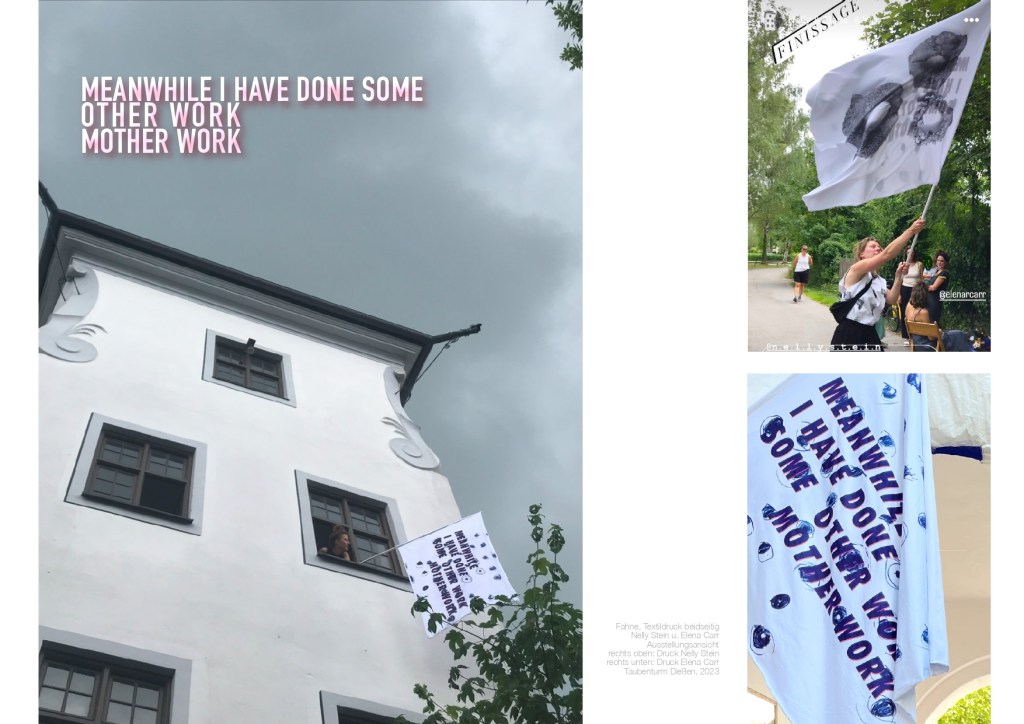
N E EINE KORRESPONDENZ curated by K. Andress and M. Rodach | Taubenturm (Dießen GER)
2022
THINGS BEING FRIENDS curated by A. E. Conrad, H. Gieseler, N. Mertes and J. Kintner | Berlin Tempelhof, Gebäude 501 (Berlin GER)
ARTIST RESIDENCY IN MOTHERHOOD (GER)
2021
EINE ORTSBESCHWIMMUNG immersive performance (adaptation), TKI_open_21 | Municipal Swimming Pools (Innsbruck and Telfs AT)
LETZTE LOCKERUNG curated by Jonas Carr | W1 (Regensburg GER)
2020
POETRY IN MOTION lecture curated by Insa Wiese | International Short Film Week (Regensburg GER)
2019
TROCKEN SCHWIMM SYNC, a swimming act performance as part of Haben und Brauchen in Wien, curated by Tim Voss | Künstlerhaus (Vienna AT)
Z COMMON GROUND ccurated by Laura Lang, Loomit and Daniel Man | Gewerbehof Zschokkestraße (Munich GER)
NACHTWÄCHTER:INNEN curated by KunstRäume am See | Max-Planck-Institut (Andechs GER)
PAPER FEED FEST curated by Risograd | Schaumbad – Freies Atelierhaus Graz (AT)
2018
HALTUNG EINNEHMEN teach-in curated by J. Hoehmann and A. Schulz | Münchner Kammerspiele (Munich GER)
K IN SUMMERCAMP performative study curated by WIENWOCHE | WERK X (Vienna AT)
PopUpKunst IM KOMPLOTT curated by Katja Sebald and Elena Carr | Marstall von Schloss Berg (Berg GER)
ALLTAGSBÜHNE BADEANSTALT immersive performance | Sargfabrik (Vienna AT)
VERLEGENE ANEKDOTEN performance curated by Maximiliane Baumgartner | Der Fahrende Raum (Munich GER)
2017
RETURNING HOME performance-installation (performer), directed by Jos Porath | Artlake Festival (Niederlausitz, GER), Gelegenheiten (Neukölln-Berlin GER)
CINEMA ROMĂNESC installation and screening | PAO (Potoc RO)
DAS GEHIRN SCHWIMMT DOCH AUCH lecture performance curated by TAMTAM | Salon Irkutsk (Munich GER)
LIEDERLICHE SUBJEKTE performance curated by Jonas Carr | Weytterturm (Straubing GER)
2016
WIR HUNDE / US DOGS, SIGNA performance-installation (performer) | Wiener Festwochen and Volkstheater (Vienna AT)
MÜDE MANÖVER performance curated by A. Schulz | Kammerspiele (Munich GER)
KARL&FABER PRIZE exhibition of the Foundation Art Academy Munich | Karl&Faber (Munich GER)
2015
SCHMIEDE WERKSCHAU group exhibition | Media Art Festival (Hallein AT)
RAUMSTATION group exhibition | Kunstpavillon (Munich GER)
WHAT’S THE DEAL? LAB exhibition as part of the Moving Urban Cultures Festival | Kreativquartier (Munich GER)
2014
SURVIVAL KIT screening How to project and spell | Chisenhale Gallery (London UK), Circuits & Currents (Athens GR), Lothringer13_Florida (Munich GER)
ASH WEDNESDAY OF THE ARTISTS kinetic installation and scenography | Frauenkirche (Munich GER)
FAHRRADKINO temporary installation in public space curated by K. Gregorian | Isarbalkon (Munich GER)
AWARDS & RESIDENCIES
2022
JUNGE KUNST UND NEUE WEGE Project Grant, Bavarian State Ministry of Science and the Arts (GER)
2021
TKI_OPEN Project Funding & Residency, Office of the Tyrolean Government and City of Innsbruck (AT)
2018
TASSILO CULTURE AWARD Süddeutsche Zeitung (GER)
2017
CULTURAL SPONSORSHIP AWARD FOR SCULPTURE City of Starnberg (GER)
2016
NESTROY PRIZE Special Prize for Wir Hunde / Us Dogs by SIGNA (Vienna AT)
KARL&FABER PRIZE Nomination, Foundation of the Munich Art Academy (GER)
ERASMUS SCHOLARSHIP Academy of Fine Arts Vienna (AT), Studio of Judith Huemer
2014
DAAD Project Grant & Residency Survival Kit research programme, Athens School of Fine Arts / Circuits & Currents (GR)
RESIDENCY Schmiede Hallein (AT) as part of „What’s the Deal?“, Cultural Department of Munich
PROFESSIONAL EXPERIENCE & EDUCATION
2025 – 2026
ROOM FOR MANOEUVRE Public Art Commission (KUNST AM BAU) | QUIVID, City of Munich (GER)
2025
Lectureship Performance & Associative Space with Prof. Dr. Notburga Karl, family-integrated residency with collaborative childcare, Academy of Fine Arts Munich in cooperation with Fritz and Maria Koenig Foundation (GER)
2023
Curation and Artistic Lead for youngcaritas in Europe | SUMMER UNIVERSITY, Werksviertel (Munich GER)
2020 – 2025
Artistic Lead for Media and Experimental Design | FOS Gestaltung, Stiftung Pfennigparade (Munich GER)
2019 – 2020
Artistic Direction of the Media Lab | spacelab, Volkshilfe Wien (Vienna AT)
2011 – 2018
Studies at the Academy of Fine Arts Munich with Prof. Res Ingold, Dr. Alexis Dworsky, Prof. Stephan Dillemuth | M.A. for Interdisciplinary Projects and 1st State Examination (GER)
2013 – 2017
STOFF AUF DEM KOPF concept and artistic direction of transcultural programmes | Stadtmuseum (Berlin GER), Kammerspiele (Munich GER), TIM (Augsburg GER), Museum für Abgüsse klassischer Bildwerke (Munich GER)
2016
SIGNA Performance-Installation, performer in Wir Hunde / Us Dogs | Volkstheater & Wiener Festwochen (Vienna AT)
Guest Studies at the Academy of Fine Arts Vienna with Prof. Judith Huemer (AT)
2015
GEHSCHREIBE workshop on kinetic objects and narrative practice | Ichoschule Giesing (Munich GER)
2013
Artistic Assistant for RAIL DOMINO installation and performance by Rooftoptiger | Castlemaine State Festival (AUS)
 installation spielskulptur performance graphic protocols artistic research